Are your business tools taking you forward? Or are they actually holding you back?
An enterprise today uses over 100 different applications. This means constantly switching between them to get work done. The problem? Too many tools to manage. The ripple effect? The IT department spends valuable time managing deployments, and workflows often remain disconnected.
Organizations need quick access to modern tools. A simple but effective solution to gain that elusive competitive edge. This is where app marketplaces within enterprise cloud environments come into play. In this blog, we look at how app marketplace solutions unlock new features. We will see how they simplify access to enterprise apps and help businesses run more efficiently.
The Challenges Enterprises Face Today
In the era of the digital, companies are under pressure to use new tools to keep up. Every new tool has its own ways to increase productivity. But it’s not always easy to get hold of them or make use of them effectively. Some challenges faced by enterprises are:
1. Application Sprawl and Blind Spots
It is not uncommon for enterprises to have a dozen or more applications they use per department. Without a centralized platform, IT teams have no visibility into:
- What applications are being actively used
- Duplicate or competing tools
- Subscription and licensing fees
This causes application sprawl. There are multiple tools to do more or less the same job, which increases costs and complicates management.
2. Gradual and Demanding Resource Deployment
The conventional application installation process consists of several stages—purchase approval, infrastructure setup, configuration, and testing.
This leads to:
- Delayed availability of essential work tools
- Greater reliance on the IT department
- Slower response to business needs
Such delays can directly affect output and time-to-market.
3. Fragmented Workflows
In the absence of integration, data is siloed within individual applications.This constitutes:
- Manual data transfer between tools
- Contradictory or duplicated information
- Restricted real-time insights into team activities
Workflow disintegrates. Workers are forced to switch between systems too often. It means there’s less time for important tasks.
4. Security and Compliance
More applications = more security concerns..
Some concerns are:
- Inconsistent access permissions: Users could have too many or old access permissions for multiple applications.
- Shadow IT: Employees use unauthorized or untracked tools without the knowledge of IT, exposing an organization to security risks.
- Data security gaps: Sensitive information is passed between applications without standardized protection measures.
- Compliance problems: Ensuring all your applications comply with regulations becomes challenging.
Trying to enforce security policies without a centralized point of control is next to impossible! The result? Data breaches and compliance violations.
5. Growing Operational Burden Overhead
It is more complex to operate when you have to deal with various vendors, licenses, updates, and support requirements. IT staff are under constant strain to maintain systems. This means they cannot focus on innovation and strategic work.
Unlocking New Possibilities With an App Marketplace
An all-in-one app marketplace in an enterprise cloud platform is a central spot. Here, organizations can browse, install, and manage applications right from their desktop. Companies are provided with a selection of curated tools. This removes the requirement to deal with various vendors and disconnected systems. All tools are meant to operate seamlessly with one another.
Solutions such as Infince realize this idea by providing a secure, enterprise‑grade app market in a single cloud space. Organizations can quickly find, purchase, and manage applications with integration across their workflows. Let’s explore how this transforms enterprise operations:
- Quick Deployment of Enterprise Apps
A key advantage of an app marketplace is the fast deployment of enterprise apps.
Organizations can launch applications in just a few clicks. This replaces lengthy installation processes. This minimizes downtime. This means that teams can begin working with new tools almost immediately. Which translates to faster rollouts. In effect, helping enterprises better keep pace with changing priorities and opportunities.
- Pre-Built Productivity Apps for Every Need
App marketplaces have many ready-made productivity apps suitable for different business functions. Whether an enterprise needs to manage a project, communicate, or analyze, there’s an app available for it. This enables them to get their requirements met without reinventing the wheel. That is cost and time savings on development.
- Streamline Workflows & Boost Productivity
Today’s toolkit users need tools that work well together. With cloud app integrations built in, app marketplaces enable seamless app-to-app collaborations. This enables businesses to automate routine work and simplify processes.
For example:
- Data can flow automatically between systems
- Notifications can trigger actions across apps
- Teams can collaborate without switching between platforms
This level of automation significantly improves productivity.
- Security & Compliance
Security continues to be paramount for enterprises that are now mobile and cloud application-driven. App marketplaces on secure, enterprise infrastructure are your best assurance that apps comply with your security standards. They check that all applications follow strict rules. This reduces risks associated with third-party tools. Centralized access control makes it easier to log in. It also keeps a secure and consistent experience for users across all apps.
A bonus with solutions like Infince is that they enhance this model by providing centralized access control and integrated compliance frameworks, allowing enterprise applications to run in a secure and trustworthy environment.
- Insights and Analytics
Another benefit of vendor marketplace apps is that you get insights and analytics.
Organizations use analytics tools to:
- monitor performance
- track usage
- make data-driven decisions
These insights help businesses continuously optimize their operations and improve efficiency.
Use Cases of App Marketplace
To see how app marketplaces affect businesses, let’s examine their real-world use:
1. HR and Employee Management
An organization uses HR management tools from an app marketplace. These solutions assist with attendance, payroll, and employee engagement. HR teams save time and reduce manual errors with integrated workflows.
2. Sales and Customer Management
Sales teams use CRM applications integrated with communication tools. This power combination enables better customer tracking and faster response times. Plus, it provides teams with a single view of all customer interactions. This is invaluable in communication and follow-up. Needless to say, this shows up as more efficient sales processes and better conversion rates.
3. Collaboration and Project Management
Teams are now using collaboration platforms that complement file-sharing and task management tools. This creates a unified cloud workspace where projects move forward smoothly. These use cases show how enterprise apps can improve daily business tasks. When offered through a marketplace, they can make a big difference.
Benefits of Using Marketplace Apps in Enterprise Clouds
There are several advantages to using an app marketplace in an enterprise cloud environment, such as the following:
| Benefit | Impact |
|---|---|
| Centralized access to applications | Simplifies discovery and usage |
| Faster deployment | Reduces delays and improves agility |
| Seamless cloud app integrations | Eliminates silos and improves workflows |
| Enhanced security | Ensures controlled access and compliance |
| Scalability | Allows businesses to grow without complexity |
How Can Infince Help
Are you ready to break down silos, boost productivity, and strengthen security controls with an efficient app marketplace?
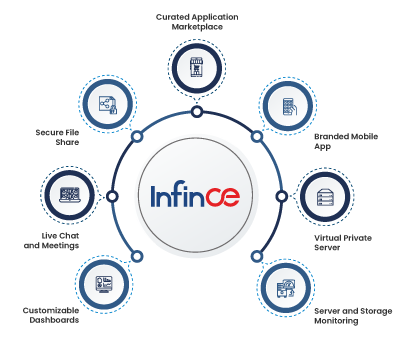
Infince brings this concept to life through its enterprise application cloud platform. In our secure private cloud, businesses can use a dedicated App Marketplace. You can easily browse, deploy, and manage applications all from one workspace. Your organization can use its current tools. Or build custom apps with marketplace solutions. This creates a truly unified ecosystem where all enterprise apps work together seamlessly. Infince makes application access simple, secure, and centralized. This unlocks new capabilities, where you can build a streamlined, scalable, and future-ready digital workplace.
Ready to simplify your enterprise applications?
Explore Infince’s App Marketplace and see how you can bring all your tools together in one secure, unified environment. Request a demo now!