App security tops the list of C-Suite Leaders priorities in multi-cloud settings. Enterprises connect apps, data, and workflows across fragmented tools and clouds. Multi-cloud has become standard protocol as teams pick standalone platforms: developers use one, sales another, finance a third. This creates gaps in controls and access points, leading to potential weak links. One weak spot can disrupt critical systems. For C-Suite Leaders, security demands ongoing attention amid these moving parts.
Multi-cloud app security is no longer a one-time project. It is a continuous discipline that has several moving parts. In this blog, we discuss the key risks and practical steps for securing applications in multi-cloud environments.
What Is a Multi‑Cloud Environment?
In a multi-cloud environment, organizations use more than one cloud provider to run applications and services. It can be a mix of public, private, and hybrid setups. Multi-cloud is different from simple “cloud sprawl.” It is a deliberate strategy where workloads are distributed across providers.
Often, business leaders are looking for ways to consolidate management while still using best-of-breed cloud services. This is where multi-cloud app security strategies and enterprise cloud suites intersect. Usually, C-suite leaders and decision-makers adopt this model to avoid vendor lock-in and improve resilience. A multi-cloud environment also helps align each workload with the cloud that best fits its cost, performance, and compliance needs.
Top security risks in multi-cloud app deployments
Security vulnerabilities in multi-cloud app management manifest as infrastructure gaps. These could be blind spots between cloud providers, tools, and teams. It can hamper data syncs and create a lack of unified data and dashboards. Teams end up wasting time piecing together logs instead of valuable work. Here are the top security risks of multi-cloud.
You Can’t See Everything in One Place
Your teams don’t have one unified view across all clouds. Each provider has its own logs, dashboards, and monitoring tools. Security issues hide in one area while alerts fire in another. This slows down how quickly you can spot threats and fix them.
More Clouds Mean More Attack Points
Every cloud you add brings new APIs, consoles, and services that need protection. This includes open ports, unpatched systems, or vulnerable APIs. An app that once had one set of endpoints to secure might now have three times as many. One breach can give attackers easy access to the rest of your systems.
Configuration Problems and Inconsistent Policies
One cloud’s storage might allow public reads by default, while another locks everything down. Your infrastructure-as-code can drift when you don’t scan across all clouds. Teams update settings in one provider and forget about the others. This creates security gaps and increases the attack surface exponentially.
Too Many User Accounts and Permissions
User identities are spread across different directories and service accounts. You don’t have one central place to see who has access to what. Old credentials from past projects stick around and become security risks. Quick “temporary” access that never gets removed can lead to bigger problems down the road.
Why You Need Integrated Security Across All Your Clouds
When your clouds are scattered, you need one layer of security that works everywhere. Apps running on different providers should follow the same rules, no matter where they’re hosted. A central platform can scan configurations, enforce policies, and track access from one spot. This eliminates blind spots where threats can hide between clouds.
Think about a logistics company with tracking apps on one cloud and billing systems on another. Without integration, a weak API connection could let data leak out. With an integrated setup, the system catches that weak link early. It applies the same encryption and access controls across both clouds. Your teams see everything in one dashboard. This means all the logs and alerts are in one place, leading to faster fixes.
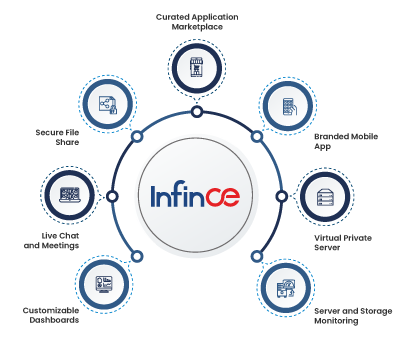
This connects directly to centralized platforms like Infince. They bring your apps and tools together into one unified digital workplace. Security becomes part of your daily workflow instead of a separate task. Governance stays tight because policies update once and apply everywhere. No more silos that slow down IT or leave security gaps.
How App Security Affects IT Efficiency and Business Continuity
Poor security drains IT resources. Your teams chase alerts across multiple clouds, manually pulling logs from different systems. Responding to a single breach can take days as people switch between tools. System downtime costs money—millions of dollars per incident on average. Customers lose trust when their data gets exposed, and they take their business elsewhere.
Strong security changes the game. Automated scans catch problems before they spread. IT teams can shift from putting out fires to building new capabilities. One retail company with tight security controls cut its incident response time in half. Better uptime means orders keep flowing without interruption.
This directly impacts how smoothly your business runs. When apps are secure, teams can access the data and tools they need without friction. Sales pulls reports without opening IT tickets. Finance runs audits faster. Your business keeps running smoothly, even during peak loads. Security stops being just a cost. Instead, it becomes an enabler, allowing your business to grow.
Key Security Strategies Every Business Leader Should Know
Getting multi-cloud security right doesn’t require complex strategies. Here are three practical approaches that deliver the right results.
Implement Unified Access Controls
Instead of managing separate logins for different cloud providers, you create one system that controls access to everything.
Start with single sign-on (SSO). Your team logs in once and gains access to all the tools they need. When someone leaves, you revoke access in one place, not many.
Role-based access control (RBAC) ensures people only see what they need for their job. A marketing manager doesn’t need access to production servers.
Multi-factor authentication (MFA) adds a second verification step. It’s one extra click for your team, but stops most unauthorized access attempts.
Enable Centralized Monitoring and Alerting
Set up log aggregation to pull security data from every cloud into one place. When something unusual happens (say, for instance, 50 failed login attempts from an unknown location), you are alerted immediately. Real-time alerts notify your security team before small issues become major incidents.
Smart alerting prevents alert fatigue. Configure notifications for actual threats, not routine activities.
Secure Data Sharing and APIs
Data constantly moves between clouds, apps, and partners. So it is best practice to always encrypt data (both when it’s moving and when it’s stored). Use API gateways as checkpoints that verify every request before allowing access. Data classification helps you protect what matters most. Customer payment data needs maximum security. Internal meeting notes need basic protection. Tag your data by sensitivity and apply the right controls automatically.
Overcoming Common Multi-Cloud Security Pitfalls
Even with solid strategies, most organizations hit similar roadblocks. Here’s how to avoid them.
Don’t Get Overwhelmed by Complexity
Multi-cloud security feels complicated because you’re dealing with different platforms, tools, and interfaces. The mistake? Trying to secure everything perfectly on day one.
Start small. Pick your most critical applications and secure them first. Once that’s working, move to the next tier. Use security tools that work across all platforms instead of learning each cloud’s native tools separately. This reduces your team’s learning curve significantly.
Bridge the Skills Gap
Your team probably knows one cloud well, but now needs to secure multiple platforms.
Invest in practical training. Send people to certification courses, but also give them sandbox environments to experiment. Create internal knowledge-sharing sessions where someone who solved a problem teaches the rest of the team.
Consider temporary outside expertise. Cloud security consultants can set up your initial architecture and train your team.
Handle Legacy Systems Smartly
You have applications built years ago that weren’t designed for multi-cloud. Don’t try to rebuild everything at once. Use API gateways and security proxies to add modern security controls without modifying legacy apps. These tools sit between old applications and the outside world, adding authentication, encryption, and monitoring automatically.
Prioritize on the basis of risk. A customer-facing app processing payments needs modern security protocols. An internal tool used by three people monthly can wait.
Conclusion: Positioning Your Organization for Secure Multi-Cloud Growth
Multi-cloud is here to stay. In fact, your organization will probably add more clouds, more applications, and more integrations in the coming years. The question isn’t whether to secure your multi-cloud environment. It’s how to do it in a way that enables growth.
The best security strategies scale with your business. When you add a new cloud provider, your security policies automatically extend to it. When you onboard a new employee, they get appropriate access on day one. When you launch a new product, security is built in from the start.
Start with the fundamentals: unified access controls, centralized monitoring, and secure data sharing. Avoid common pitfalls by learning from others who’ve gone before you. Complexity, skills gaps, legacy systems, and policy inconsistencies trip up most organizations. Expect these challenges and plan for them instead of being surprised when they appear.
Most importantly, tie security to business outcomes. Security isn’t about blocking people from doing their jobs. It’s about enabling them to do their jobs safely. When sales can share proposals securely, when developers can ship features confidently, when finance can access data without IT tickets, that’s security working as a business enabler.
Platforms like Infince help bring this vision to life by unifying your digital workplace while keeping security central. Instead of managing security separately for each tool and cloud, you get one integrated environment. Multi-cloud gives you speed and flexibility. Strong security gives you confidence and resilience. With Infince, you can position your organization to grow, adapt, and succeed no matter what comes next.
Test drive Infince for free today. Request a free demo now!