infince logo
  • Home
  • Apps
  • Solutions
    • By Function
      • Digital Workplace
      • Employee Engagement Platform
      • Remote Work Platform
      • Employee Intranet Software
      • Internal Communication Software
      • Social Intranet Platform
      • Mobile Intranet
    • By Role
      • IT Managers
      • HR Managers
      • New Business Owner
    • Alternatives
      • Google Workspace Alternative
      • Microsoft 365 Alternative
      • Sharepoint Alternative
  • Resources
    • Help
    • FAQs
    • Blogs
    • Videos
    • Case Studies
    • White Paper
    • Guides
    • Ebooks
    • Use Cases
    • Release Notes
  • Pricing
  • Login
Request a Demo

Category: Technology

5 Features of Infince that will Transform The Way You Work

  • Small Business
  • Technology
  • Business Software

How Infince Transforms the Way Your Workforce Operates Today

As vaccine trials show promising results, the world is in high hopes of recovering from the COVID-19 pandemic slowly. But the scale at which vaccination needs to happen, conquering challenges in production, logistics, demographic, political, and societal scenarios, is huge and hence it may take time for the total eradication of the virus. This means, the new norm of working for most companies wherein a good majority of their employees work from home, is likely to continue for the long term. However, 2020 witnessed the massive change of modern workplace software being increasingly brought to the traditional workforce wherein it only took a matter of days for millions of employees to work at the same pace from their home as they would from their office.

One of the most celebrated enterprise collaboration and digital platform for small and medium businesses during the COVID-19 pandemic was Infince. Some of the most demanding businesses managed to successfully keep their staff engaged and productive through seamless collaboration courtesy of Infince. 

Read More: Top 10 Alternatives to Microsoft Teams that Aid Remote Work in 2020

Today, let us take a look at the 5 key features of Infince that make it an undisputed leader in enabling better employee collaboration and transforming the way employees work remotely.

1. Easy Information Access

When employees work remotely, the biggest hurdle they face is getting information about their job activities at the earliest. With Infince’s cloud-based platform, companies can create a centralized virtual repository of all company information that employees can access based on their job roles. Infince allows privileged access control options to ensure that confidential or sensitive files and data are made available only to the right stakeholders and with proper logging of access to ensure transparency. 

The best part is that employees can access this information on the go right from the comfort of their smartphones thereby providing more flexibility. This allows them to plan better responses for customer-facing job objectives.

2. Improved Collaboration

With Infince, enterprises can create virtual workspace platforms wherein teams working on a project can converge and collaborate digitally. Be it brainstorming for solutions and ideas, daily standup meetings, project progress meetings, the platform allows all team members to digitally meet in one place.  You can securely share files, work together on documents, communicate via instant messaging, manage dependencies in work together, and create custom dashboards- both at the individual level or at the team/ department level to visually track and analyze what’s happening in your business. 

Read more: 5 Benefits Of Having A Centralized Employee Dashboard In Your Business

Collaboration is propelled to the next level as employees can carry out almost all sorts of work activities together just as how they would do so when they were at the office. This is facilitated irrespective of where your employee may be based out, anywhere on the globe.

3. Budget Friendliness

When a pandemic rips through economies worldwide, it is important for companies to preserve operational cash flow to the maximum possible limit. For this to happen, they need to enable a digital-first environment for employees that don’t burn a hole in their pockets. Infince has always been built for the cloud-centric enterprise of tomorrow. With a range of subscription pricing plans, the digital enterprise platform offers more value for every single dollar spent as a subscription charge. 

Infince offers small and medium businesses the flexibility to save on costs since they only pay for the features and scale they consume from the platform. This helps them significantly boost their operating margins as expenditure comes down drastically. The additional savings can go a long way in helping businesses preserve cash and sustain profitable operations in challenging times.

4. Secure Digital Infrastructure

Today’s businesses deal with a large volume of sensitive customer data that needs to be accessed and shared between multiple employees across different departments. When your entire work environment turns into a remote one due to a global pandemic, the concerns regarding data security heightens to new levels. This is where Infince assures peace of mind with its state-of-the-art security credentials. The platform offers you the choice to run your digital enterprise infrastructure on a secure private cloud location which can be monitored and managed effectively by your technology team without worrying about security threats.

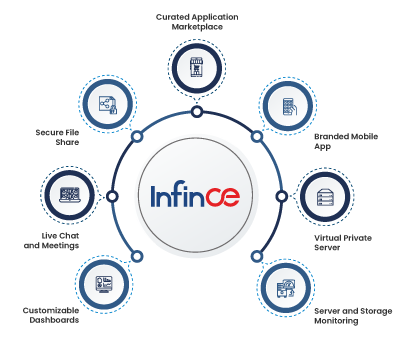
From building your website to offering a secure intranet, Infince offers all the IT set up needed to run your business under one roof! Infince provides you a dedicated and secured cloud-hosted IT infrastructure comprising a private email server, dedicated virtual servers, virtual desktop infrastructure (VDI), intranet for internal communication, and custom website builder. 

Read more: How Infince enables you to quickly transit to remote working

5. Long List of Applications

Over the years, Infince has grown a large community of applications under its ecosystem that enables businesses to streamline productivity and improve engagement levels of their employees. Additionally, the platform also allows small and medium businesses to experience the digital transformation of their key growth activities like human resource management, marketing, and sales by introducing applications for CRM, marketing automation, HCM, and much more. 

The list of supporting apps for the Infince ecosystem has been steadily growing which makes it a complete digital package for today’s businesses. Infince helps you build a branded cloud platform with customization options to match your brand identity.

As your business operations are increasingly being disrupted, it is becoming clear that there is a need to rapidly transition your operational model to accommodate a highly digital-friendly workforce that can work from anywhere. Infince takes you closer to this goal by creating the most secure and cost-efficient yet feature-rich experience for your business’s digital infrastructure. Get in touch with us to know more.

I am a Product Consultant, living at the intersection of empathy, design, engineering and helping teams craft Products that bring a smile. I believe that technology best serves its purpose when we use it to address deep problems without losing sight of the human nature of its users. Truly transformative technology is one that seamlessly becomes part of the daily narrative of its customers, aiding them to achieve their goals faster and easier.

More posts by Ashni Lukose

Related Posts

5 KPIs that Matter to Every Small Business

Focus on these 5 KPIs to improve small business growth The journey of building a successful small business involves several…Read More

Why Does Employee Well-being Matter in a Hybrid Work Model?

Remote and hybrid work has gained more popularity during and after the outbreak of Covid-19. Flexible work has been found…Read More

Improving Virtual Desktop Infrastructure Performance with Real-time Monitoring

Benefits of Monitoring Your Virtual Desktop Infrastructure in Real-time As more and more companies send their workforces to operate remotely,…Read More

The Blueprint for the Ultimate Intranet Software in 2024

Raising the bar on communication, collaboration, and productivity have been three crucial factors driving change across the post-pandemic remote and…Read More

Popular Posts

  • Tackling Top 10 Technology Challenges of Small Businesses
  • Major Web Hosting Challenges and Solutions
  • Effective Work From Home Tips – Infographic
  • 10 Key Factors to Consider While Choosing An Intranet Platform
  • How Intranets Solve Workplace Challenges

    Stay up to date on the latest in Digital Workplace Trends


    Manage your entire business from one place with the complete cloud platform InfinCE.

    Request a Demo

    5 Benefits Of Having A Centralized Employee Dashboard In Your Business

    • Small Business
    • Technology

    Can centralized dashboards improve workplace productivity?

    Dashboards are often an intrinsic part of today’s business world. From helping executives and leaders make decisions to enable seamless forecasting of business opportunities, they play a key role in the corporate world. But this curated information repository is not just meant for reporting and senior leadership alone. In today’s highly decentralized workforce environment that is increasingly being pushed to a remote future with a pandemic like COVID-19, employee dashboards are becoming a vital part of the workforce as well.

    There is a huge demand for easy access to information within an organization at all levels. Several teams require access to different kinds of information like for example, project management dashboards where different project activities and tasks are managed, CRM dashboards that give a holistic view of marketing and sales activities, attendance and leave management dashboards for depicting employee activities and much more. 

    Read more: 5 Key Features Every Project Management Dashboard Should Offer

    With remote working becoming a norm, here are 5 ways in which having a centralized dashboard can improve your businesses efficiency and work productivity:

    1. Overview in a snapshot

    A workforce dashboard for any department offers a comprehensive yet highly precise snapshot of the team’s or company’s performance. From getting inputs about a project task to viewing the progress of service requests, the employee dashboard enables the workforce to transparently seek information on demand. 

    By customizing the nature of information available across departments, job levels, and roles, it is possible for organizations to roll out tailored initiatives for each individual and enable them to track their progress at each stage. It also gives a single source of truth for all employees to be able to stay updated with what’s happening across their operational units, departments, or job roles within the company.

    Read more: Creating Organizational, Department, Team and Personal Dashboards using Infince

    2. Setting up organization goals

    With a customizable company dashboard, it is easy for the senior leadership to create a new objective, break it down into achievable components and keep track of each of these components which have been assigned to different teams. This whole activity can be easily represented as a goal on the company dashboard with defined metrics. It can be seen by all employees who can also track its growth, view achievement milestones, calculate their own effort needed to help in progressing each component, and much more. 

    In short, a dashboard helps companies take up smaller initiatives that add value to long term company goals and keep track of how every individual effort within the company contributes to this value.

    Read more: Focus on these 5 KPIs to improve small business growth

    3. Learning and Development

    A centralized employee dashboard can be the sole information source employees can access to advance their career aspirations within the company. Learning paths can be defined with help from senior leaders, progress in learning initiatives can be tracked and achievements can be recognized and rewarded across job levels with the help of a transparent dashboard. 

    It is also possible to set up company-wide learning initiatives with specific instructions, standardized learning curriculum, and certifications and this information can be used for future performance and other metric calculations as well.

    4. Improve Visibility

    When the management evaluates performance, productivity, and other vital business parameters, it is often presumed that employees are left in the dark about the progress made. With centralized dashboards, it is now possible for senior leaders to easily communicate the information down to the lowest levels of job roles within the organization. 

    Employees can see visual reports of the company’s growth, performance assessment steps, and percentages of teams, intuitive breakdown of career goals and how they are aligned to performance benchmarks, and so on. This helps to create transparency within the workplace. Employees feel that they are treated and rewarded fairly when it comes to matters such as performance ratings, payment revisions, etc. It also sets a clear path for employees to identify their weaknesses and improve on areas that need focus.

    Read more: 5 Tips To Foster Team Collaboration In A Small Business Environment

    5. Staying Connected

    An employee dashboard is not just about reports and charts that give a view of the daily operations of the company. It is more like an intranet portal where employees get together virtually for sharing information, staying connected with their friends at the workplace, exchange conversations, and much more. Organizations on the other hand have a medium to channel content directly to employees transparently. 

    Important announcements, events, virtual meet-ups, etc. can all be facilitated smoothly through an interactive and intuitive employee dashboard. When most of your employees work from their homes in times such as the COVID-19 pandemic era, this will greatly enhance their work morale and also create a relaxed working environment that does not allow physical meetups for a long tenure.

    A centralized dashboard creates a better working experience for all employees and is vital in creating a highly engaged and motivated workforce. When most employees work remotely, this is a key factor that is hard to ignore for enterprises. Now the question arises as to how to set up this dashboard. This is where Infince can be your solution. 


    The comprehensive enterprise digital platform of Infince allows you to create powerful employee management and an operational dashboard that serves all purposes outlined above. Get in touch with us to explore how Infince can be the game changer in your workforce operations.

    Currently leading and managing a highly talented group of developers to produce an unmatched futuristic complex cost effective cloud product which can compete with technology giants.

    More posts by Ishaque Valasseri

    Related Posts

    5 Tips to Analyze and Select the Right Business Intranet Solution

    How to Evaluate and Choose the Right Intranet Software for Your Business A business intranet is a portal that gives…Read More

    5 Common Remote Work Challenges Solved by Infince Digital Workplace Platform

    Infince Digital Workplace Platform Resolves The Persistent Challenges in Remote Work The COVID-19 pandemic has pushed organizations worldwide to adopt…Read More

    Digital Workplace: What It Is and Isn’t?

    Everything You Need to Know About Digital Workplace The term "digital workplace" has seen too many interpretations over the past…Read More

    6 Ways Infince Simplifies IT Infrastructure Management For Enterprises

    How Does Infince IT Infrastructure Management Software Help Your Business A reliable and robust IT infrastructure management strategy is crucial…Read More

    Popular Posts

    • Tackling Top 10 Technology Challenges of Small Businesses
    • Major Web Hosting Challenges and Solutions
    • Effective Work From Home Tips – Infographic
    • 10 Key Factors to Consider While Choosing An Intranet Platform
    • How Intranets Solve Workplace Challenges

      Stay up to date on the latest in Digital Workplace Trends


      Manage your entire business from one place with the complete cloud platform InfinCE.

      Request a Demo

      4 Tips To Attain Success In The New Normal Remote Work Environment

      • Small Business
      • Technology

      How can businesses succeed with employees working completely remotely?

      One of the major implications of the COVID-19 lockdowns is the shift from an office-based work environment to the remote work mode. Even sectors that had previously taken a cold approach to let their employees work from home have suddenly become flag bearers of the work from anywhere culture. Dynata’s Global Consumer Trends: COVID-19 survey series reveal that the lines between work and home life are getting significantly blurred. The report also says that most people prefer the work from home culture to stay around, at least for some more time. 

      In the US alone, nearly half of the working population has transitioned into a completely remote work mode since the outbreak began in early 2020. However, as the pandemic is showing mild signs of receding and vaccine developments are moving into promising trials, the question of whether the remote work culture will prevail for the long term has risen in the corporate boardrooms.

      Changing Work Lives in the New Normal

      When employees started to work continuously from home, some of the key challenges that concerned senior leadership were productivity, security, and client timeline commitments. However, the trends witnessed across the globe were largely positive in these 3 areas with several organizations reporting that their staff productivity levels were in fact much higher when they worked from home rather than in the office. In Dynata’s survey, 75% of respondents report that their productivity levels are high while at home than they were in office, with considerable travel time saved. 

      Read more: How To Build A Highly Productive Remote Workforce

      So the question that should really concern the senior leadership is how to succeed in this new normal of working remotely if it is the future of work?

      To remain successful while adapting to a long term remote working culture, companies need to make strategic changes in their policies, technology infrastructure, and their cultural approach to ensure that all employees stay united in their objectives while working apart. 

      Here are 4 tips that we suggest to accelerate successful operations with a remote workforce:

      1. Set up a transparent communication policy

      One of the major elements of unifying diverse team members working remotely is through regular communication. Employees need to have a source to continuously engage with their peers, seniors, managers, or even the leadership in the company to address the challenges they face daily as well as gain insights into their work objectives. 

      Companies need to break down their legacy hierarchy of communication and create an open environment where even the top leadership executives are available at the touch of a button on an employee’s phone. Leaders need to take their employees into confidence by regularly communicating updates about the company’s growth, business and service performance metrics, initiatives to keep employees motivated, and much more.

      Read more: 5 Best Practices To Enable Seamless Communication For Your Remote Workforce

      2. Create a specialized procurement team

      The challenges in enabling a remote working environment can be solved to a great extent when setting up an effective procurement team to assess, identify and procure relevant technical, managerial, and operational assets required for specific work contexts. When this team gets things done faster, employees gain quicker access to their work assets irrespective of their location. 

      For empowering your procurement team, you need to provide them with the right tools for strategic sourcing, managing contracts with vendors for various assets, intelligent reporting, and purchase management.

      3. Create a collaboration platform

      Enabling a transparent communication policy is only one side of the coin. Investing in a powerful digital platform to enable this communication is the other side. Employees who work remotely need to collaborate with their peers on different work tasks daily. They also need a place to get insights, reviews, and feedback on their work, company objectives, business, and other relevant aspects related to their career. 

      This is where a powerful and collaborative intranet portal like Infince makes sense for your business. Remote work collaboration platforms like Infince enable better collaboration, reduce friction on dependent tasks, and support unified goal fulfilment for distributed team members. The platform will also serve as a place where employees can feel reminiscent of their office virtually.

      Read more: 5 Points To Consider While Choosing Your Enterprise Collaboration Software

      4. Seamless Project Management

      When remote teams are involved in client projects, there should be a smooth mechanism for managers to oversee projects, give instructions and guidelines, set expectations, and track progress. Only then will the organization as a whole be able to meet commitments made to clients and improve trust in the process. 

      For distributed teams, there should be a seamless project management capability via a digital platform that can be used to assign, monitor and track progress of tasks at different levels ranging from individual to teams working on modular components of a project to the entire organization or service delivery unit as a whole. When project management is streamlined, it will facilitate transparent client reporting and improved credibility for your brand.

      COVID-19 was a catalyst for a change that is well poised to remain a stronghold of tomorrow’s workforce. The future of work may be changed forever as we know it and to remain successful, companies must rethink their strategies of work from a cultural and practical perspective. 

      Read more:  5 Tips To Effectively Manage Remote Teams During Challenging Times

      It has been proven beyond doubt that with the right culture, adequate digital infrastructure, and transparent communication, you can run your business remotely with unified management. The main asset you need is a digital backbone that will connect various units within your business to enable seamless workforce operations and support sustainable growth. This is where Infince can make a difference. Get in touch with us to learn how Infince can help you accomplish success in the new normal of “work from anywhere!”

      I am a Product Consultant, living at the intersection of empathy, design, engineering and helping teams craft Products that bring a smile. I believe that technology best serves its purpose when we use it to address deep problems without losing sight of the human nature of its users. Truly transformative technology is one that seamlessly becomes part of the daily narrative of its customers, aiding them to achieve their goals faster and easier.

      More posts by Ashni Lukose

      Related Posts

      10 Ways to Redefine Your Intranet to Improve Employee Experience

      How to Improve Your Intranet for Better Employee Experience Technology advancements and modern communication tools have changed the entire landscape…Read More

      5 Tips to Select the Ideal Web Hosting Partner

      Did you know that if visitors encounter just a second of delay in loading your website, then it is estimated…Read More

      INFINCE Presents A Technology Guide For Small Businesses

      District Hall, 75 Northern Ave., Boston, 6pm April, 2019: On 4th April 2019, INFINCE is sponsoring a free workshop targeting…Read More

      6 Ways to Build a Secure File Sharing Practice Within Your Organization

      6 Tips to Ensure Secure File Transfers Within Your Organization To survive tough market conditions like dynamic consumer trends and…Read More

      Popular Posts

      • Tackling Top 10 Technology Challenges of Small Businesses
      • Major Web Hosting Challenges and Solutions
      • Effective Work From Home Tips – Infographic
      • 10 Key Factors to Consider While Choosing An Intranet Platform
      • How Intranets Solve Workplace Challenges

        Stay up to date on the latest in Digital Workplace Trends


        Manage your entire business from one place with the complete cloud platform InfinCE.

        Request a Demo

        5 Points To Consider While Choosing Your Enterprise Collaboration Software

        • Small Business
        • Technology
        • Business Software

        How can businesses pick the right enterprise collaboration platform?

        Recently, we wrote about the leading online collaboration tools that facilitate remote work in 2020 and which are the best alternatives to Microsoft Teams your business can consider. We know how important it must be for you to facilitate remote work collaboration among your teams positioned far and wide, at their homes or co-working spaces. That’s why this time we decided to share a few tips on what all you need to consider while choosing the best enterprise collaboration software for your business. 

        Half the year down, COVID-19 is still doing its rounds worldwide, pushing the economy to a slow reopening after months of lockdown. While some countries are experiencing drastic spikes in the number of cases, others are witnessing a gradual decline of cases. Irrespective of their geographical positions, a huge section of the global workforce is poised to continue working remotely for a long time to come in the interest of safety.

        Read more: 5 Tips To Effectively Manage Remote Teams During Challenging Times

        So, here are 5 things you need to keep in mind while choosing an enterprise collaboration platform for your business:

        1. Evaluate your needs

        All modern-day enterprise collaboration platforms have tons of features and each of these features may sound exciting when you hear or explore them initially. However, not all businesses need all these features to be present in their collaboration software. You need to go back to the drawing board, run a campaign internally within your workforce to identify the challenges they face in collaboration, the tools, and support they need through a collaboration platform, and then have a look at features offered by leading vendors. This will help to keep your digital infrastructure optimized and personalized according to the needs of your workforce. 

        Rather than the management implementing a platform that is most appealing to them, the focus here is to garner requirements from the actual workforce who would be using this platform for collaboration and then pick a vendor that offers these features on demand.

        2. Scalability

        It is likely that every collaboration software you came across in your search will be a cloud-based one. Thus, you assume that they will be scalable. But scalability is not restricted to just storage on the cloud. By scalability, we mean the ability of the platform to grow across all dimensions as more departments and processes in your business go into the platform. It includes support for feature additions, easy development of new features, accommodating multiple processes and new policies over time, and above all, handles more complex computing needs in the future based on your business’s growth. 

        A digital collaboration platform is not something that you invest and implement for the short term. It will be a crucial digital platform that will grow with your business and adapt to changing work trends in the future.

        Read More: How IT Teams Can Prepare to Support Remote Workforce During COVID-19

        3. Cost Efficiency

        As described in one of the previous points, your business may not need all features as advertised by vendors. By subscribing to more features, you will end up paying more on the subscription fee if the platform offers a “pay for what you use” model of subscription. Some features may be needed only in the future when your business grows and more employees use these features. Hence a platform that allows you to configure your subscription is the most desired option from a cost perspective. Once you identify the features you really need as described earlier, you can pick a vendor that offers you the freedom to pay for only those features on demand.

        4. Security

        When almost all of your employees work remotely, it is likely that confidential and sensitive customer information will be handled through the enterprise collaboration platform you deploy. Hence there needs to be an adequate security protocol in place within the software that lets you make governing policies on data and information exchange within the digital environment. Permissioned access, transparent work and project management, logged activities, etc. will be required to ensure that there is no compromise in security.

        Read more: Why Is Infince A Better Choice For Safe Video Calling Than Zoom

        5. Usability

        When employees are suddenly moved into a new paradigm of working, there will be disruptive impacts on their daily routine. On top of that, if they are allotted a new collaboration platform without adequate onboarding time and awareness, the chaos will multiply many folds. To make a smoother transition into a new enterprise collaboration software, companies must pick a digital platform that has a high focus on usability and provides a comprehensive support and training exercise to help make the transition seamless. 

        These tips could be video demonstrations, how to use manuals, a comprehensive FAQ section, dedicated support associates available all time, and much more. Platforms with intuitive interfaces and a shorter learning curve can be given preference for quicker adoption in your workforce.

        The remote work culture is here to stay for a long time. We did not mean to say that there will not be a return to the office, but even when work resumes from office, employees would certainly feel much more comfortable to avail of Work from Home options occasionally. The pandemic showed us that it is possible to maintain your productivity levels while working from home to be on par with an office-based culture. 

        Read more: How Infince Helps You Quickly Transit to Remote Working

        Hence the only requirement is that you make the right collaboration platform available to employees. With secure information policies, seamless cloud-based deployment and management, Infince offers the best enterprise collaboration platform for today’s businesses. Get in touch with us to explore more. 

        Currently leading and managing a highly talented group of developers to produce an unmatched futuristic complex cost effective cloud product which can compete with technology giants.

        More posts by Ishaque Valasseri

        Related Posts

        Why is It Necessary to Safeguard Data Privacy in Project Management?

        The work from home approach has become the norm in the business world in the post-COVID-19 era. A recent survey…Read More

        5 Ways an Integrated Cloud Platform is Beneficial for Your Small Business

        How can an integrated cloud platform turn your business competitive? Across the world, businesses of all sizes are increasingly managing…Read More

        How Does The Intranet Contribute To Digital Employee Experience

        Introduction Are you struggling to retain top talent in your organization? You're not alone. Resignations are rising, with many employees…Read More

        What is Hybrid Cloud Identity and Why It Matters for Your Business

        Embracing cloud technologies is one of the typical components of digital transformation. According to a Gartner report, “By 2024, more…Read More

        Popular Posts

        • Tackling Top 10 Technology Challenges of Small Businesses
        • Major Web Hosting Challenges and Solutions
        • Effective Work From Home Tips – Infographic
        • 10 Key Factors to Consider While Choosing An Intranet Platform
        • How Intranets Solve Workplace Challenges

          Stay up to date on the latest in Digital Workplace Trends


          Manage your entire business from one place with the complete cloud platform InfinCE.

          Request a Demo

          5 Tips To Effectively Manage Remote Teams During Challenging Times

          • Small Business
          • Technology

          5 tips to run your workforce remotely during COVID-19

          The global economy is undergoing a tremendous shift as the COVID-19 pandemic rips through boundaries of trade, social interactions, and travel. With more businesses forced to let go of their stringent office-based work culture and transition into a remote working model, there are a rising number of challenges that employers must learn to cope with. With the pandemic showing vague signs of receding any time soon, it is important for businesses to learn to efficiently manage remote teams and ensure disruption-free customer service from their business. So how can they achieve this excellence of managing remote employees?

          Here are 5 tips to effectively manage remote teams during challenging times:

          1. Set Protocols and Agreements

          Before you start to assign work orders or schedule delivery timelines for remote teams, it is important to arrive at a consensus on the operational model for remote employee management. Though lockdown and other government regulations indicate fewer chances of people moving out of their homes (except emergencies), it is important to set the terms on operating hours clearly so that the work-life balance of employees isn’t affected. 

          Read more: 8 easy tips to effectively work from home

          Organizations need to follow up with employees not only on work-related proceedings but also on the personal health and safety of the employees and their family members. As such, companies need to publish and make managers aware of availability guidelines for work. Employees need to be offered flexible working hours when they are continuously working remotely as they may need to attend to personal priorities as well.

          2. Strategically Plan Meetings and Reviews

          It is important for managers and their reports to be in sync with assigned workloads and ensure timely submission of customer deliverables. While provisions for any time communication will always be there, it is better to create a schedule to review work progress. 

          There could be weekly or bi-weekly team review calls that can happen over video conferencing for the entire team to come together and interact as if they were in an office meeting. Task dependencies, support, and other mutually concerning matters can be taken up for discussions and managerial interventions could be made wherever necessary. 

          One-on-One meetings between managers and employees who report to them should also be a trend that should ideally occur on a monthly basis. While the type of meetings can be sorted and agreed upon by employees, it is important to follow a time-sensitive schedule for such meetings. Ideally, any non-core meeting shouldn’t be scheduled for more than 30 minutes.

          3. Leverage Collaboration Platforms

          When employees work remotely, there is often a need for them to work together on achieving the desired results or customer deliverable value. Since meeting up at the office isn’t feasible under situations like COVID-19, companies must look at alternative ways to facilitate collaborative work arrangements. 

          The best option is to have a powerful remote collaboration platform like Infince that can create a virtual workspace for employees to work together as a team on projects. From file sharing to virtual conferencing involving the entire team, digital platforms like Infince allow better project management and easy collaboration on customer deliverables. 

          Read more: How Infince helps you quickly transit to remote working

          Since customer data or other valuable credentials are likely to be managed by employees using these collaboration platforms, they need to offer high levels of security. It is important to maintain logs and traceable information on these platforms to ensure there is no compromise on security.

          4. Organize Information

          While it is a good thing to have multiple communication channels open for employees when they work remotely, it is equally important to have a well balanced and organized communication strategy to avoid distractions and eliminate loss of productivity due to these distractions. 

          Effective use of project management tools, virtual repositories, file organizers, and knowledge management platforms can help streamline work communication efficiently. Employees can access information needed for work support, view their pending tasks, prioritize work, view progress of dependent tasks, and do much more when there is a structured and well laid out information and communication management practice. This allows remote work teams to be transparent about work commitments and avoid overwhelming responsibilities.

          Read more: 5 Best Practices To Enable Seamless Communication For Your Remote Workforce

          5. Encourage Engagement

          While the merry of an office environment will always be missed in remote work culture, there is nothing that will stop you from setting up an engaging work experience when all staff works remotely. Try hosting weekly fun activities, brainteasers, music, and fun activities all via video conferencing so that employees get to connect with the fun side of their work more frequently. It is also a great gesture to allow families of employees to participate as it will create more social bonding. Use social media to promote employee engagement. 

          Read more: 5 Ways To Improve Business Growth Through Employee Engagement

          Managing your remote workforce efficiently in times of crisis like the COVID-19 pandemic can be less stressful if you have the proper digital infrastructure in place to support your workforce. This is where platforms like Infince has proven to be a game-changer for some of the world’s most successful businesses. Get in touch with our experts to learn more.

          I am a Product Consultant, living at the intersection of empathy, design, engineering and helping teams craft Products that bring a smile. I believe that technology best serves its purpose when we use it to address deep problems without losing sight of the human nature of its users. Truly transformative technology is one that seamlessly becomes part of the daily narrative of its customers, aiding them to achieve their goals faster and easier.

          More posts by Ashni Lukose

          Related Posts

          7 Reasons for a Small Business to Adopt Cloud Business Phone System

          Why should small businesses invest in a cloud business phone system In the past, a business phone system was not…Read More

          4 Tips While Choosing a Task Management Software

          We live in a hyperconnected world, one that is bogged down by excess information and multiple tasks. Task management software…Read More

          Transform your Data Sharing Practices to Win Customer Trust?

          Data sharing is increasingly battling data-privacy concerns in an AI-dominated business society. As a result, organizations must be exceedingly cautious…Read More

          How IT Teams Can Prepare to Support Remote Workforce During COVID-19

          4 ways to bolster your IT team’s efficiency to support remote operations during COVID-19 It’s only the second week of…Read More

          Popular Posts

          • Tackling Top 10 Technology Challenges of Small Businesses
          • Major Web Hosting Challenges and Solutions
          • Effective Work From Home Tips – Infographic
          • 10 Key Factors to Consider While Choosing An Intranet Platform
          • How Intranets Solve Workplace Challenges

            Stay up to date on the latest in Digital Workplace Trends


            Manage your entire business from one place with the complete cloud platform InfinCE.

            Request a Demo

            11 Online Collaboration Tools That Facilitate Remote Work In 2020

            • Small Business
            • Technology

            Here is a list of the leading remote collaboration tools of 2020

            We’re nearing the halfway mark of 2020, and most of the world’s working population has shifted to remote working. This transition would not have been possible if powerful digital collaboration tools for employees to stay connected were not available. From schools to IT companies, every organization has integrated an online communication and collaboration platform to help their workforce carry out daily operations smoothly and interact with their peers, customers, or any relevant stakeholders in their work. 

            Read more: 5 Best Practices To Enable Seamless Communication For Your Remote Workforce

            Here is a look at the top 11 online collaboration tools that made a difference for businesses in 2020 during the COVID-19 pandemic:

            1. Infince

            While collaboration and communication are the key elements to look forward while choosing a digital platform for your business, Infince offers enterprises with a host of other features in addition to the key elements like an integrated CRM, Rich management dashboards, cloud-based secure web hosting, virtual desktops and much more. It is one of the best online collaboration tools for small and medium businesses.

            2. Microsoft Office 365 and Teams

            One of the most popular players in the global software industry, Microsoft has helped numerous organizations manage their remote work operations smoothly with their pool of collaboration tools and platforms. From productivity tools like MS Word, Excel, etc. to video and conferencing solutions like MS Teams, they offer a large set of options for businesses to choose from.

            3.  Slack

            Slack definitely needs no introduction to several global companies as it has helped millions to collaborate efficiently even before the COVID-19 pandemic took things in a different direction. Offering personalized experiences, video and team conferencing, mobile app support, and seamless integration with popular cloud storage services, Slack offers a solution for all your remote work needs.

            4. Zoho Cliq

            From simplifying team communication to managing real-time messaging, task schedules, and automation, Zoho Cliq offers enterprises of all sizes with a comprehensive suite of collaboration tools. It also offers easy integration with other 3rd party platforms for storage, calendar management and even offers easy management of customer relationships by integrating seamlessly with Zoho’s own established CRM solution.

            5. Trello

            Trello has a massive fan base across the globe, be it amongst organizations or individual freelancers and consultants. The primary reason for this fan following is undoubtedly the simplicity of the platform to help organize multiple tasks that require collaboration from a number of employees. The simple interface and easy navigation within individual Trello cards help managers and employees to handle even complex projects efficiently with Trello and it integrates well with other platforms such as Slack, Google Drive, GitHub, etc. to make the experience even more rewarding for teams.

            6. Asana

            From organizing workflows, tracking work progress, and facilitating seamless communication, Asana is still one of the veterans in the online collaboration space and has been around since 2008. Companies like Intel and Uber rely on Asana as their core communication platform to stay organized, enable better conversations between staff, and manage diverse projects and their individual task progress.

            7.  Google G-Suite

            Undoubtedly one of the world’s most well-known tech brands, Google doesn’t want to be left behind in the race for online collaboration tools. Its G-Suite platform offers a host of capabilities with a collection of apps for various enterprise collaboration activities. You have everything from emails to video conferencing to productivity apps all rolled into different subscription plans that you may feel free to choose depending on your organization’s size. With top-notch security, support, and scalability, G-Suite is a trusted platform for thousands of businesses worldwide to help run their operations smoothly.

            Read more: 5 Workplace Innovations You Can Welcome with Video Conferencing

            8. Ryver

            Ryver offers a simple and easy to use interface for employees to connect and converse within an enterprise. From the ease of setting up teams to offering privileged features to different groups and the ability to manage private virtual spaces for individual project discussions, Ryver has grown into a strategic internal tool for several modern-day businesses. A major highlight of Ryver is the Facebook inspired intranet feed where employees can converse together/with each other on updates shared by the organization.

            9. Facebook for Work

            How amazing it would be if virtual office collaboration tools work similarly to Facebook with the same theme and inspired layouts? Well, this is exactly what Facebook themselves tried to offer when they launched the Facebook for Work platform. From productivity apps to seamless communication channels, the social media giant has brought several inspiring features into the product aimed at making internal enterprise communication interesting.

            10. Podio

            Podio makes for a great mobile-friendly workforce communication and collaboration platform. It offers flexible configuration options and easy integration with several functional and productivity apps like Evernote, Google Drive, Dropbox, and much more.

            11.  Basecamp

            A darling of technology service companies, Basecamp brings together a very useful set of capabilities for communication and collaboration under one roof. With a highly affordable fee for unlimited teams, it finds tremendous use in companies with more staff.

            Read more: 4 ways to bolster your IT team’s efficiency to support remote operations during COVID-19

            With COVID-19 showing minimal signs of weakening, your business will be in dire need of an online collaboration platform to help employees stay connected. Get in touch with us to explore why Infince will be your best choice among the 11 we have covered in this blog.

            I am a Product Consultant, living at the intersection of empathy, design, engineering and helping teams craft Products that bring a smile. I believe that technology best serves its purpose when we use it to address deep problems without losing sight of the human nature of its users. Truly transformative technology is one that seamlessly becomes part of the daily narrative of its customers, aiding them to achieve their goals faster and easier.

            More posts by Ashni Lukose

            Related Posts

            5 Crucial Metrics to be Tracked in Your KPI Dashboard Software

            Is your KPI Tracking Software pursuing these 5 metrics? Achieving sustainable growth is vital for businesses of all sizes today.…Read More

            Why Infince Digital Workplace Should be Your Remote Work Companion

            Why Your Digital Workplace Needs a Robust Solution like Infince  The need for having a digital workplace culture is loud…Read More

            Choosing the Right Enterprise Cloud Suite: A Comprehensive Guide!

            Of course, AI is driving headlines across all industries today. But, quietly in the background, the cloud has become an…Read More

            Why Is Infince A Better Choice For Safe Video Calling Than Zoom

            4 Reasons to Use Infince for Remote Workforce Collaboration COVID-19 pandemic has pushed more than half of the world population…Read More

            Popular Posts

            • Tackling Top 10 Technology Challenges of Small Businesses
            • Major Web Hosting Challenges and Solutions
            • Effective Work From Home Tips – Infographic
            • 10 Key Factors to Consider While Choosing An Intranet Platform
            • How Intranets Solve Workplace Challenges

              Stay up to date on the latest in Digital Workplace Trends


              Manage your entire business from one place with the complete cloud platform InfinCE.

              Request a Demo

              How IT Teams Can Prepare to Support Remote Workforce During COVID-19

              • Small Business
              • Technology
              • Business Software

              4 ways to bolster your IT team’s efficiency to support remote operations during COVID-19

              It’s only the second week of June 2020 and the total number of confirmed COVID-19 cases worldwide has come close to 7.15 million. Governments, businesses, and people have started to realize that we may need to learn to live with the coronavirus for an unexpected period of time, at least until vaccines are found that can neutralize or eliminate its threat for good. Businesses and universities have transitioned their core operations to adopt a remote work culture. Except for some critical work operations that require a physical presence in the workplace, almost all companies now operate with employees working out of their homes.

              Read More: Effective Work From Home Tips – Infographic

              What does this mean for the IT department across businesses who have moved into a remote work operation mode? 

              IT teams need to quickly support the transition of the entire IT work infrastructure into a near 100% remote mode. From productivity tools to instant peer communication platforms, everything needs to be available for employees irrespective of where they are located. 

              Here are some best practices you can utilize to get your IT team prepared for keeping your employees connected to their workplace virtually during such uncertain times.

              1. Set Communication Policies

              While remote working employees need access to multiple communication channels to effectively work on their tasks, it is important for companies to define the clear scope of each channel. One example would be an optimal usage of paid communication channels like VOIP facilities with limited licenses or shared licenses between departments. 

              There should be a minimum availability of each such resource and policies must be laid out to ensure optimal utilization. 

              Read More: How can businesses manage their remote workforce through efficient communication?

              For example, if teleconferencing between team members of a project requires more time and more users to be connected to a single conference call, it can be moved to an online meeting platform that offers unlimited conferencing options rather than using limited license telephone-based VOIP conferences. This offers your IT team the flexibility to allot VOIP facilities to more demanding teams like customer-facing employees who may find it difficult to ask customers to get into online meetings rather than just a conversation over the telephone.

              2. Secure Information Access

              When employees work from their office, confidential information regarding customer projects may be distributed in local networks which could only be accessed from office computers. 

              When there is a shift to remote working, this information should go into a more distributed storage facility that can be accessed over the internet. Hence a proper security policy and protocol must be defined for flexible information access over the internet. This allows IT teams to implement monitoring systems, maintain access logs, set privileged access options, and much more. 

              Moreover, all employees need to be strictly made aware of these policies through regular communication from leaders, managers, and HR. Security should not be the sole responsibility of your IT team but an extended oversight of the entire workforce.

              Read More: Why Is Infince A Better Choice For Safe Video Calling Than Zoom

              3. Provisioning of Digital Platforms and Tools

              There is a huge demand for collaboration and communication platforms when employees work together on projects. The demand escalates to unprecedented levels when your stakeholders shift to a remote mode. 

              From meetings to file sharing to project management, there is a multitude of managerial overhead for facilitating seamless operations while employees are working from home. 

              This calls for the implementation of a powerful digital enterprise platform like Infince which can offer different departments within your organization the necessary digital tools and platforms for communication and collaboration. Such platforms make it easy for your IT team to manage overall digital infrastructure availability for remote workers and make support readily available for their needs at any time.

              Read More: Best Practices to Remotely Manage Your Business During COVID-19

              4. Measure, Analyze and Improve

              For many businesses, this is probably the first instance where such a massive remote working policy came into force and that too in a very short notice. Glitches and delays are expected, but the key focus here should be to learn from each event and ensure a better experience the next time. 

              It is important to regularly measure productivity levels of staff and align it with IT objectives such as availability, file management, security and data policies, software and license management, etc. 

              Set out clear KPIs for measuring employee productivity during the timeline of remote work. The measured values should be analyzed to arrive at trends that occur in work patterns frequently. Feedback from employees should be collected with regards to infrastructural availability, network, or communication channel flexibility, etc. Learnings from all these should be factored in while your IT department optimizes your digital infrastructure to meet rising demands from your workforce.

              Read More: How Infince helps you quickly transit to remote working

              The remote work culture is expected to remain a norm for months to come as the COVID-19 pandemic is not showing a dramatic rate of containment of spread. Your IT teams need the most resilient enterprise IT platforms to help manage complex requirements of the entire workforce who are working remotely. This is where enterprise platforms like Infince can be their best friend. Get in touch with us to know how some of the world’s best businesses manage their digital workforce infrastructure seamlessly with Infince. 

              Currently leading and managing a highly talented group of developers to produce an unmatched futuristic complex cost effective cloud product which can compete with technology giants.

              More posts by Ishaque Valasseri

              Related Posts

              6 Key Trends Reshaping the Way Social Intranets Work

              Social intranet platforms have become indispensable for businesses, facilitating communication, collaboration, and knowledge sharing among employees.  Picture this: a dynamic…Read More

              7 Top Ways To Engage Your Employees & Users On Intranet!

              An intranet is a computer network comprising various operational systems and other computer services, created exclusively for internal communication and…Read More

              Improving Virtual Desktop Infrastructure Performance with Real-time Monitoring

              Benefits of Monitoring Your Virtual Desktop Infrastructure in Real-time As more and more companies send their workforces to operate remotely,…Read More

              3 Ways a Workplace App Helps Manage Your Business During COVID-19

              The Key Benefits of Using a Unified Workplace App for Modern Businesses The COVID-19 pandemic has drastically changed every aspect…Read More

              Popular Posts

              • Tackling Top 10 Technology Challenges of Small Businesses
              • Major Web Hosting Challenges and Solutions
              • Effective Work From Home Tips – Infographic
              • 10 Key Factors to Consider While Choosing An Intranet Platform
              • How Intranets Solve Workplace Challenges

                Stay up to date on the latest in Digital Workplace Trends


                Manage your entire business from one place with the complete cloud platform InfinCE.

                Request a Demo

                5 Best Practices To Enable Seamless Communication For Your Remote Workforce

                • Small Business
                • Technology

                How can businesses manage their remote workforce through efficient communication?

                As the COVID-19 pandemic continues to ravage global health and economy, most businesses are beginning to accept the fact that they need to change their work culture to help sustain operations during such difficult times. One of the most successful ways that businesses small and large have followed to remain operational during the pandemic was by implementing remote workforce management at a larger scale.

                Almost all staff of several organizations except those in critical roles that demanded physical presence at the office were asked to work from their homes. Several companies expect this form of work from home culture to last throughout the rest of 2020 or even extend beyond into the next year. With remote work culture becoming a mainstream norm, employers need to understand the importance of communication when a majority of their workforce is working independently out of their homes.

                Here are 5 best practices that you need to incorporate to effectively communicate with your remote workforce:

                Read More: Best Practices to Remotely Manage Your Business During COVID-19

                1. Set Guidelines for Communication

                When almost everyone works remotely to deliver business services, it is important for employers to set standard communication policies and protocols to prevent any disconnects or inconvenience from occurring due to lack of physical proximity. 

                Your staff needs to be made aware of the different communication channels that are available, which to use for different scenarios, and how to approach others by respecting their privacy while working from homes. 

                There needs to be a proper understanding of business hours and the need to complete any official communication cycles within stipulated working hours to ensure that employees get to spend quality time with their families as well.

                Read More: Effective Work From Home Tips – Infographic

                2. Ensure a Seamless Communication Platform

                The first step to empower your remote workforce to stay connected with their peer groups or the larger organization as a whole is to ensure the availability of world-class communication platforms. 

                Having an email tool alone will not be enough to facilitate seamless communication. 

                From instant messaging to social media-inspired intranet feeds, your business must set up a comprehensive platform that allows employees to stay connected, informed, and engaged throughout their work schedules. A digital platform can unify communication efforts, help co-ordinate multiple tasks simultaneously, and help employees to easily gain access to support from their peers or management.

                3. Proactive Work Communication

                It is important to ensure that employees are not left out of communications related to work updates or new service requirements. You cannot expect employees to put in their best effort if you reach out to them at the last moment with requirements which may even include direct customer interactions. Managers need to plan work schedules in advance and communicate the same to employees for them to plan and manage workloads efficiently.

                4. Encourage Video Calls

                When employees stay away from the office for months together and work remotely, it is natural that they feel a sense of incompleteness in their work schedules. The frequent tea break chats, lunch and dinner outings, workplace fun activities will all be missed terribly and this can add up stress levels. As the situation doesn’t permit employees to catch up with their peers directly, the best solution could be to encourage meetings and discussions to happen over video conferencing. 

                It will be much easier for employees to work together or maintain their relationships when they frequently see each other and interact with video conferencing. Video calls bring in a sense of togetherness virtually for teams who are distributed at different locations.

                Read More: 5 Workplace Innovations You Can Welcome with Video Conferencing

                5. Transparent Leadership Communication

                As you work on strategies to remain sustainable in your business operations during the COVID-19 pandemic, it is equally important to keep your employees updated on the progress of the same. You need to assure them on aspects such as their job security, business performance updates, and other important strategic initiatives that you plan to take to combat the scenario. It is important to keep your employee communications transparent and ensure that they can freely reach out to the highest management level should a need arise for support. 

                Read More: Infince Helps You Quickly Transit to Remote Working

                Your employees are your biggest asset and it is important to establish a clear communication channel for them to alleviate their fears. This communication could be established through newsletters, video broadcasting of leaderships, Q&A surveys, feedback collection, etc. which could all happen on a weekly or monthly basis.

                The new workforce management culture induced by COVID-19 is sure to pave the way for a future of open work policies wherein employees can work from anywhere they want and only ensure that quality work is delivered on time. As businesses, you need to have in place the proper communication and collaboration channel for your workforce to operate seamlessly during remote operations. This is where Infince can be a game-changer in your business. Get in touch with us to explore how Infince can create the best remote working digital infrastructure for your business to tide over a crisis like the COVID-19 pandemic.

                Currently leading and managing a highly talented group of developers to produce an unmatched futuristic complex cost effective cloud product which can compete with technology giants.

                More posts by Ishaque Valasseri

                Related Posts

                How To Build A Highly Productive Remote Workforce

                5 Ways To Run A Successful Business With Remote Employees Gone are the days when a key measure for success…Read More

                Top 5 Productivity Tools Every Small Business Needs Today

                5 Must-have Productivity Tools For Your Workforce We live in an age where time is money. For entrepreneurs, this is…Read More

                Internal communications Trends – 2024

                In today's hyper-connected digital landscape, communication is not just a tool; it's a strategic cornerstone for organizational success. The world…Read More

                5 Tips To Effectively Manage Remote Teams During Challenging Times

                5 tips to run your workforce remotely during COVID-19 The global economy is undergoing a tremendous shift as the COVID-19…Read More

                Popular Posts

                • Tackling Top 10 Technology Challenges of Small Businesses
                • Major Web Hosting Challenges and Solutions
                • Effective Work From Home Tips – Infographic
                • 10 Key Factors to Consider While Choosing An Intranet Platform
                • How Intranets Solve Workplace Challenges

                  Stay up to date on the latest in Digital Workplace Trends


                  Manage your entire business from one place with the complete cloud platform InfinCE.

                  Request a Demo

                  Best Practices to Remotely Manage Your Business During COVID-19

                  • Small Business
                  • Technology

                  How SMBs can attain positive business outcomes from remote working

                  It’s barely 6 months into 2020 and COVID-19 has pushed more than half of the world into some form of lockdown. Businesses are losing revenue either due to shutdown or lack of customers. Travel restrictions and social distancing norms are forcing small and medium businesses to limit their operating hours and ask their staff to work remotely most of the time.

                  However, the remote work culture isn’t that bad as many companies have found it to be a savior in this pandemic. In fact, a good majority of small and medium businesses are now of the opinion that they can continue this mode of remote work even post the pandemic as it will reduce operational costs significantly. 

                  Related Reading: How Infince Helps You Quickly Transit to Remote Working

                  So, the question on everyone’s mind now is “How can we manage the business efficiently during and after the COVID-19 pandemic with a remote workforce?” Here are 4 tips to help you out:

                  1. Improve Communication

                  The most important aspect of maintaining relationships with your employees when they work remotely is communication. As employers, you need to facilitate a seamless communication experience for employees to interact with each other, share information, and foster a culture of continuous engagement. 

                  Remote work collaboration platforms like Infince facilitate this by offering a seamless communication platform that allows employees to interact over a variety of channels such as instant messaging, video calls, video meeting conferences, and much more. By ensuring that employees have the means to communicate efficiently, you can assure consistent productivity levels while they are working remotely.

                  Related Reading: Why Is Infince A Better Choice For Safe Video Calling Than Zoom

                  2. Empower Collaboration

                  Most of the daily work done by your employees influence end customer service quality. It also requires the contributions from multiple teams working on different facets of a project or customer engagement. There needs to be a seamless collaboration mechanism that has to be in place to help employees easily connect with their peers, exchange information and files securely, set up meetings and discussions, manage projects virtually with diligence, and so on. To facilitate these activities, SMBs require a powerful virtual collaboration and enterprise management platform. 

                  Related Reading: 5 Tips To Foster Team Collaboration In A Small Business Environment

                  Security is a prime essential when you choose a collaboration platform for your remote workforce since your employees need to handle sensitive customer information like financial data or social security credentials.

                  3. Promote Work-Life Balance

                  It is true that remote working was one of the most preferred ways to guarantee a healthy work-life balance for employees. But such a scenario wasn’t meant to be for such a long period of time and that too with almost everyone in the family also at home due to the pandemic induced lockdowns. 

                  As employers, you need to understand that an employee may not be always capable of putting in their 100% concentration on their computers while at home. They may have to attend to their kids or spouse or parents periodically and engage in some quality family time. As such, you need to instruct managers to be strict on time commitments just for the sake of making it an 8- or 9-hour working day. Let employees take breaks in between and work in their comfort zones keeping in mind only the quality of the work they are engaged in. You will be amazed to find that employee engagement and productivity levels would improve under such a relaxed schedule.

                  4. Team Bonding

                  While it might take a while before everyone gets back to their old office regime and talk to friends and colleagues over a sip of coffee in the pantry, there are a lot of activities that companies can initiate over digital platforms to help improve team bonding when everyone works remotely. There could be weekly fun activities where teams can participate over video calls and they can even involve their families who might be around at home. There are several competitions that the HR team can run online, and employees can participate to remind themselves of the fun they had while at the office. In times like these, such positive motivational activities would be much appreciated by employees.

                  Related Reading: Effective Work From Home Tips – Infographic

                  Managing your business successfully during the COVID-19 pandemic with a remote workforce requires more than just interpersonal skills. A digital backbone is essential to ensure seamless communication and collaboration between your employees to ensure disruption-free customer service. This is where Infince can be your one-stop solution to managing your entire business operations remotely. Our cloud-based enterprise platform offers a host of features ranging from communication to collaboration to help enterprises build a sustainable workforce culture during the pandemic situation. Talk to our experts to learn more. 

                  I am a Product Consultant, living at the intersection of empathy, design, engineering and helping teams craft Products that bring a smile. I believe that technology best serves its purpose when we use it to address deep problems without losing sight of the human nature of its users. Truly transformative technology is one that seamlessly becomes part of the daily narrative of its customers, aiding them to achieve their goals faster and easier.

                  More posts by Ashni Lukose

                  Related Posts

                  7 Reasons Why You Need a Mobile Intranet

                  Modern workplaces are evolving beyond the traditional, 9 to 5 desk-bound culture. Legacy internal communication tools are giving way to…Read More

                  5 Ways an All-in-One Enterprise Cloud Platform Cuts IT Costs and Boosts ROI

                  Let’s say your IT team is managing over fifty third-party software applications. Each month, your company faces vendor invoices, security…Read More

                  Top 10 Alternatives to Microsoft Teams that Aid Remote Work in 2023 and Beyond

                  Ever since the pandemic brought in the dynamics of remote work and hybrid models, Microsoft Teams has become a household…Read More

                  Driving Organizational Culture with Social Intranet Platforms

                  Today’s workforce needs more than effective policies and aesthetically built workspaces. Its digitally driven landscape demands an interconnected work culture…Read More

                  Popular Posts

                  • Tackling Top 10 Technology Challenges of Small Businesses
                  • Major Web Hosting Challenges and Solutions
                  • Effective Work From Home Tips – Infographic
                  • 10 Key Factors to Consider While Choosing An Intranet Platform
                  • How Intranets Solve Workplace Challenges

                    Stay up to date on the latest in Digital Workplace Trends


                    Manage your entire business from one place with the complete cloud platform InfinCE.

                    Request a Demo

                    5 Video Marketing Trends That Every SMB Needs To Follow

                    • Small Business
                    • Technology

                    As the competition tightens and consumers have more choices, small businesses often face the challenge of bringing the message out about their products and services. In other words, they seek innovative marketing opportunities to improve sales. Today, one of the biggest assets a small business can rely on to market their offerings is undoubtedly video marketing. If you are wondering why these figures will prove it:

                    • Up to 16 hours of video is consumed over the internet by a user every week (Forbes)
                    • 66% of all consumers would like to learn about a product through video demonstrations (Wyzowl)
                    • 71% of marketers agree that video converts more prospects into leads than any other form of content (Vidyard)

                    So now that you understood the impact video marketing can make, it is time to have a look at what the industry demands today in terms of video content and approach. 

                    See Also: Creative Marketing Videos of Infince

                    Here is a short glimpse of the top video marketing trends for small businesses in 2020:

                    1. Stories of Inspiration

                    Plain product demonstrations or glitzy advertisement videos many not excite today’s crowd. Besides, expensive advertisement videos may not be a good option for small and medium businesses as they need more financial muscle to run their core operations rather than diverting all funds into just marketing. So, the best way forward is to come with inspiring themes for your brand story. 

                    People tend to side more with brands that can resonate with stories of common folks who made it big. By pushing out such a story and getting a connection to your business diligently, the video you make creates a lasting impact that will reside in consumer memory for a long time.

                    2. Smart Video Creation Services

                    Today, there are several video-making apps and websites that allow you to create simple yet powerful video clips that position your brand appropriately. Once you have the script ready, it is just a matter of choosing a platform. It takes just over 20 minutes or so to make a video if you have ready-made templates and simple editing tools. While sophisticated tools and specialist editors can do a better job, it is always good to try something fresh on your own using the numerous tools and platforms available today.

                    Related Reading: Becoming Small Business Leaders In 2020: What You Need To Know

                    3. Optimized for Channels

                    A decade ago, videos were primarily hosted and viewed on YouTube. Fast forward to today, social media platforms like Facebook, Instagram, Twitter, Snapchat, etc., are the new arena for video distribution and viewership. The biggest advantage is the large social interaction capability on video content that is facilitated by these social networks. 

                    Videos that go viral on Facebook and Twitter bring unprecedented traffic to businesses that marketed it. So, a small business that wants to target video marketing today needs to create videos that are optimized for different social media channels. The optimization is not just on file size but also on the length of the video, content tone and voice, demographic choices for scenarios, and much more. 

                    The number of personalization options you can try with social media-based video marketing is tremendous. The right fit video can change the fortunes of your business in a matter of hours or days.

                    4. Shorter videos in larger frequencies

                    Videos are not just a tool to demonstrate product features but can be used as an informative piece of content like what blogs do. Thus, a healthy video publishing schedule is a growing trend among small businesses today that wish to succeed with video marketing. 

                    The videos would be short and crisp in terms of messaging and context but they need to be published more frequently, say for example, twice a month. Some businesses go to the extend of publishing one every week. The more video content you have, the greater are the opportunities to win customer loyalty through regular posting.

                    Related Reading: 5 Digital Capabilities Every Small Business Needs To Invest In 2020

                    5. Interactive Videos

                    While this may not be possible for all kinds of businesses all the time, every small business can consider publishing an interactive video message at least once in their marketing calendar. With VR and AR devices becoming more mainstream, more people have the capability to view interactive video content at their convenience. The most important element for small businesses to consider while generating interactive video content is to incorporate their core business activity in the video theme.

                    If your small business is not capitalizing on video marketing, then it is missing out on a big opportunity to grab a sizeable number of potential leads. Videos are the best way to improve engagement and build brand loyalty. Once leads turn into deals, you have to be prepared to meet customer expectations. This is where operational efficiency and digital proficiency take the driver’s seat. To ensure a seamless digital-first experience in your business, get in touch with us to explore the possibilities of Infince – one of the best digital business platforms for small and medium businesses.

                    Currently leading and managing a highly talented group of developers to produce an unmatched futuristic complex cost effective cloud product which can compete with technology giants.

                    More posts by Ishaque Valasseri

                    Related Posts

                    How a Unified Environment Promotes a Successful Digital Workplace

                    A digital workspace is the virtual equivalent of your individual workstation. It is an integrated technology framework that leverages evolving…Read More

                    Navigating the Digital Hub: Transforming Your Company Intranet for Enhanced Connectivity and Productivity

                    A company intranet is a private network accessible only to an organization's staff. Often, a wide range of information and…Read More

                    Infince to Sponsor Virtual Conference by Digital Workplace Experience!

                    Infince to sponsor a virtual conference organized by the Digital Workplace Experience! With digital work culture on the spur, business…Read More

                    Choosing the Right Enterprise Cloud Suite: A Comprehensive Guide!

                    Of course, AI is driving headlines across all industries today. But, quietly in the background, the cloud has become an…Read More

                    Popular Posts

                    • Tackling Top 10 Technology Challenges of Small Businesses
                    • Major Web Hosting Challenges and Solutions
                    • Effective Work From Home Tips – Infographic
                    • 10 Key Factors to Consider While Choosing An Intranet Platform
                    • How Intranets Solve Workplace Challenges

                      Stay up to date on the latest in Digital Workplace Trends


                      Manage your entire business from one place with the complete cloud platform InfinCE.

                      Request a Demo

                      Posts navigation

                      Older posts
                      Newer posts
                      infince logo
                      awards awards awards awards
                      Terms and Conditions Privacy Policy

                      Company

                      • About Us
                      • Pricing
                      • Request Demo
                      • Why Infince
                      • Contact Us

                      Contact

                      • [email protected]
                      • +1-833-463-4623

                      2026 Infince. All rights reserved by Fingent. Infince is developed and supported by fingent logo